Aug 27, 2026
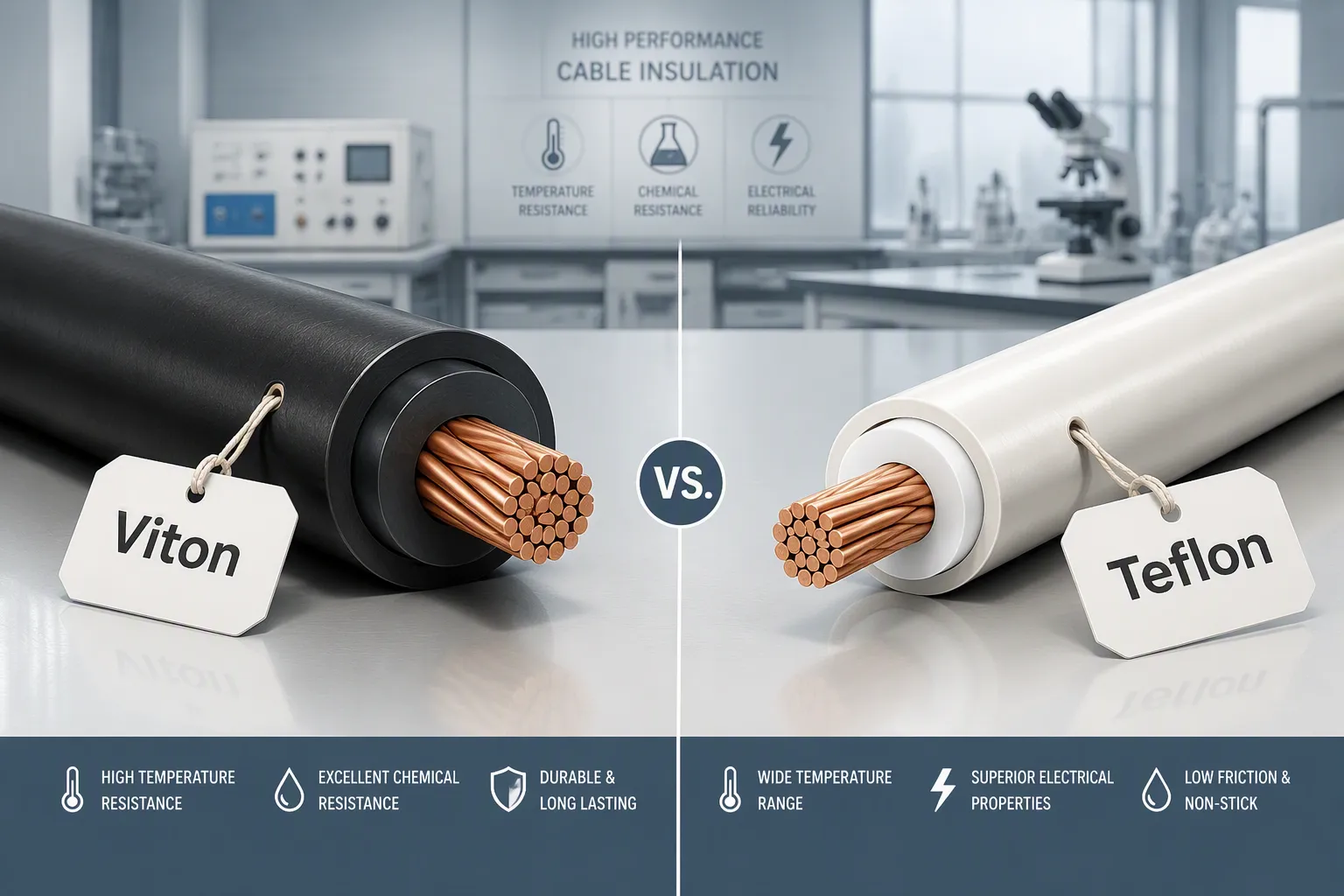
Choosing between Viton cable vs Teflon cable requires you to match polymer properties to your operating environment. Viton Cable is a flexible elastomer; Teflon is a rigid fluoropolymer. That structural difference drives every performance characteristic you must evaluate.
You need to compare four factors: temperature range, chemical resistance, flexibility, and cost. Teflon withstands extreme heat up to 450°C and resists virtually all chemicals. Viton excels in dynamic, high-flex applications and delivers superior sealing performance.
Your decision framework starts here. Citcable engineers recommend you assess your specific demands before selecting. This guide gives you the criteria to make that call with confidence.
Key Takeaways
Choose Viton for dynamic applications that need flexibility and oil resistance.
Choose Teflon for extreme heat and aggressive chemical environments.
Teflon handles higher temperatures and more chemicals than Viton.
Viton costs 20-40% less than Teflon but has a shorter lifespan in harsh conditions.
Match the cable material to your specific operating conditions for best performance.
What Is Viton Cable?
Viton Cable refers to products manufactured with Viton, the brand name for FKM (fluorocarbon rubber). This material belongs to the elastomer family, meaning it behaves as a flexible, rubber-like polymer rather than a rigid plastic. You will find this distinction critical when you compare it against Teflon, which is a stiff fluoropolymer. The molecular structure of FKM gives you a material that returns to its original shape after deformation, a property that defines its performance in demanding applications.
A Flexible Elastomer for Harsh Environments
You get exceptional resilience from Viton's elastomeric nature. It withstands continuous temperatures from -20°C (-4°F) to +204°C (399°F), with intermittent exposure reaching up to +316°C (600°F). This range covers most industrial heat scenarios without compromising the material's integrity. The polymer resists cracking and hardening even after prolonged thermal cycling, which makes it a reliable choice for environments where other rubbers fail.
Chemical resistance varies by agent, and you must match the fluid to the material. The table below summarizes FKM's performance across common industrial chemicals:
Chemical Environment
FKM Rating
Hydrocarbons (fuel, oil)
Excellent
Mineral acids (H₂SO₄, HCl)
Good
Ketones (acetone, MEK)
Severe Effect
Esters (ethyl acetate)
Severe Effect
Strong amines
Severe Effect
Steam/hot water
Fair/Poor
You can rely on Viton for fuel systems, hydraulic lines, and mineral oil applications. However, you should avoid exposing it to ketones, esters, or strong amines, as these chemicals degrade the polymer rapidly. For a flexible cable jacket in automotive or aerospace settings, Viton delivers dependable sealing and protection against oils and fuels.
Typical Uses in Sealing and Dynamic Applications
You will find Viton Cable in cable jackets, connectors, and seals across aerospace, automotive, and chemical processing industries. Its flexibility suits dynamic applications where cables bend repeatedly. Robotic arms, moving machine parts, and vibration-prone equipment all benefit from this material's flex life. Citcable engineers recommend Viton when your application demands both chemical resistance and mechanical endurance. The elastomer absorbs stress without cracking, which extends service life in high-motion environments. You also gain excellent ozone and UV resistance, making outdoor installations viable. When your priority is a durable, flexible cable jacket that seals against hydrocarbons, Viton Cable offers a proven solution.
What Is Teflon Cable?
Teflon Cable uses PTFE (polytetrafluoroethylene), a rigid fluoropolymer plastic. Unlike Viton's rubber-like elasticity, Teflon maintains its shape under mechanical stress. This structural rigidity defines its performance profile. You get a material that prioritizes thermal and chemical endurance over flexibility.
A Rigid Fluoropolymer with Extreme Ratings
Teflon stands as the most heat-resistant cable insulation available. Continuous operating temperatures range from -60°C to +200°C, with short-term spikes exceeding 260°C without degradation. Certain PTFE wire constructions carry ratings from 125°C to 450°C for specialized high-temperature applications. This thermal headroom makes Teflon the default choice for environments where other polymers soften or melt.
The electrical properties of Teflon are equally remarkable. Its dielectric constant sits at 2.0-2.1, among the lowest of any solid material. The dissipation factor remains below 0.0002 at 1 GHz, preserving signal integrity at microwave frequencies. Dielectric strength reaches 30-60 kV/mm, while volume resistivity approaches 10¹⁸ Ω·cm. Arc resistance exceeds 165 seconds, adding a safety margin for high-voltage systems.
Property
Value
Dielectric Strength
30–60 kV/mm
Volume Resistivity
~10¹⁸ Ω·cm
Dielectric Constant
2.0–2.1
Arc Resistance
>165 seconds
Where Teflon Excels in Electrical and Thermal Applications
You will find Teflon Cable dominating high-frequency signal transmission. Coaxial cables and high-speed data links rely on PTFE insulation to minimize signal delays and capacitive coupling. PTFE fiber insulation with 40-70% void fraction achieves dielectric constants of 1.5-1.8, enabling continuous processing for communication systems up to 1 GHz. The material's natural flame resistance adds inherent safety for electrical installations.
Extreme thermal environments also favor Teflon. Downhole oil and gas multi-conductor cables operate up to 280°C and 25,000 psi using compression-resistant PTFE fillers. Industrial and aerospace applications benefit from two-layer PTFE constructions with enhanced adhesion of 2-5 N/mm, preventing conductor slippage under tensile forces. For high temperature cable applications, Teflon remains soft and flexible even after extended heat exposure. Citcable engineers specify Teflon when chemical resistance and thermal stability outweigh flexibility requirements. The material's near-total inertness makes it the safer choice for aggressive chemical processing environments.
Temperature Resistance: Which Handles More Heat?
Temperature resistance drives the material decision in many installations. Teflon Cable offers a broader operating window than Viton, making it the clear choice for extreme thermal environments. You must evaluate both the upper and lower limits of your application. The temperature rating directly affects cable lifespan, safety margins, and overall system reliability.
Comparing Maximum Continuous Ratings
The table below summarizes the temperature capabilities of both materials:
Parameter
Viton FKM
Teflon PTFE
Continuous operating range
-20°C to +200°C
-60°C to +200°C
Intermittent maximum
+316°C
+260°C+
Low-temperature special grade
-40°C (GF grade)
Not required
Best application fit
Moderate heat, dynamic flex
Extreme heat, static install
Teflon PTFE withstands continuous operating temperatures from -60°C to +200°C. Short-term spikes can exceed 260°C without material degradation. Specialized PTFE wire constructions carry ratings from 125°C to 450°C for demanding high-temperature scenarios. The material maintains its electrical properties across this entire range, preserving signal integrity even under extreme heat.
Viton FKM operates continuously from -20°C to +200°C. Intermittent exposure can reach +316°C without compromising the material's integrity. While Viton handles most industrial heat scenarios effectively, its upper limit falls short of Teflon's capability. For applications that push beyond 200°C on a regular basis, you should select a high temperature cable designed with PTFE insulation. The elastomer withstands thermal cycling well, resisting cracking after repeated heating and cooling cycles.
The difference becomes critical in specific environments. Industrial ovens, engine compartments, and exhaust systems generate sustained heat above 250°C. Viton cannot maintain its properties at these levels for extended periods. Teflon retains its electrical and mechanical characteristics, ensuring reliable performance. Citcable engineers recommend Teflon for any installation where ambient temperatures exceed 200°C during normal operation. The higher initial cost of Teflon cable often pays for itself through reduced downtime and longer service life.
Consider the thermal profile of your application carefully. A cable operating near its maximum rating degrades faster than one with ample thermal headroom. Teflon provides that margin for high-heat environments. Viton delivers adequate performance for moderate heat conditions with the added benefit of flexibility. When you select a cable with insufficient temperature rating, you risk insulation failure, short circuits, and system downtime. Matching the material to your thermal environment ensures long-term reliability.
Performance in Extreme Cold
Low-temperature performance varies significantly between the two polymers. Standard-grade Viton operates down to -20°C. Below this threshold, the elastomer loses flexibility and becomes brittle. A low-temperature GF grade extends the operating range to -40°C, providing additional margin for cold environments. The specific compound formulation determines the exact limit, and you should verify the grade before installation. For comparison, silicone O-rings extend down to -55°C, indicating that Viton is not the optimal choice for extreme cold environments.
Teflon does not exhibit the same cold-temperature limitations. The material maintains flexibility at substantially lower temperatures than Viton. While specific minimum operating data varies by formulation, Teflon consistently outperforms Viton in extreme cold. For applications in arctic environments, cryogenic systems, or high-altitude installations, Teflon provides a safer operating margin. The rigid fluoropolymer structure does not become brittle in the same way that elastomers do at low temperatures.
Both materials function adequately in typical cold conditions. Refrigerated storage areas, outdoor installations in temperate climates, and cold-weather equipment all fall within the operating range of both polymers. The distinction matters only when you approach the lower boundaries. At -40°C, a standard Viton cable may fail while a Teflon cable continues to perform. Your decision should account for the coldest temperature your cable will encounter during operation or storage. If your application requires operation below -40°C, Teflon represents the only viable choice between these two materials. Cable routing in cold storage facilities, outdoor equipment in northern climates, and aircraft systems all demand reliable low-temperature performance. Your choice between Viton and Teflon depends on the minimum temperature your cable must endure.
Chemical Resistance: A Tale of Two Polymers
Chemical resistance separates these two materials more sharply than any other property. Viton excels against hydrocarbons, oils, and fuels. Teflon resists virtually every chemical you encounter in industrial settings. Your choice depends on the specific fluids in your environment.
The table below compares ratings for key industrial chemicals where the two materials diverge:
Chemical
FKM (Viton)
PTFE (Teflon)
Mineral Oil
Excellent
Excellent
Gasoline
Excellent
Excellent
Acetone
Fair
Excellent
Sodium Hydroxide
Fair
Excellent
Ammonia
Severe Effect
Excellent
Brake Fluid (Glycol-based)
Severe Effect
Excellent
Viton's Strength Against Oils and Fuels
You can rely on Viton for automotive and aerospace fluid systems. It receives an 'Excellent' rating for oil and fuel resistance. Viton keeps its shape and does not swell or crack when exposed to oil or fuel. It maintains flexibility in high-heat engine environments. Fuel-injection O-rings, crankshaft seals, camshaft seals, and turbo seals all depend on Viton's performance. The elastomer withstands petroleum oils and fuels without degradation. However, you must avoid exposing Viton to ketones, esters, strong amines, or glycol-based brake fluids. These chemicals cause severe swelling. For a chemical resistant cable in fuel-rich environments, Viton offers a proven solution.
Teflon's Near-Total Inertness
Teflon achieves a level of chemical resistance that few materials match. It earns an 'Excellent' rating for nearly every chemical in the table above. The polymer remains completely inert when exposed to common acids, bases, solvents, and oxidizers. Only a small group of extremely aggressive reagents can overcome Teflon's resistance. Molten alkali metals like sodium and potassium strip fluorine atoms from the polymer chain. Potent fluorinating agents such as fluorine gas and chlorine trifluoride disrupt the carbon-fluorine bonds. For every other chemical you encounter in industrial processing, Teflon remains unaffected.
Teflon's near-invincibility is overcome only by a small, specific group of extremely aggressive reagents. For nearly all common acids, bases, solvents, and oxidizers, Teflon remains completely inert.
You should select Teflon for the most aggressive chemical environments. Chemical processing plants, laboratory equipment, and pharmaceutical manufacturing all benefit from PTFE's inertness. Sulfuric acid, hydrochloric acid, and nitric acid at any concentration leave Teflon unchanged. Citcable engineers recommend Teflon when chemical exposure spans multiple chemical families or includes substances known to attack elastomers.
Flexibility and Mechanical Durability
Mechanical stress separates these two polymers more decisively than any other property. You must consider how your cable moves during operation. Static installations tolerate rigid materials. Dynamic systems demand flexibility. The table below summarizes the mechanical profile of each material:
Property
Viton FKM
Teflon PTFE
Flex life
Excellent
Poor
Abrasion resistance
Good
Excellent
Tear strength
High
Low
Best application
Dynamic, moving parts
Static, fixed routing
Viton's Superior Flex Life
Viton's elastomeric structure delivers outstanding resistance to repeated bending. The polymer chains return to their original configuration after deformation. This recovery mechanism prevents crack propagation and fatigue failure. You can route a flexible cable jacket made from Viton through tight radii, around pulleys, and across articulating joints without compromising its integrity.
Robotic arms represent the ideal use case. Each cycle bends the cable through a defined arc. Viton absorbs this stress continuously. The material withstands millions of flex cycles without developing surface cracks or losing its sealing properties. Automotive applications benefit equally. Engine compartments vibrate constantly. Wiring harnesses must endure this motion without insulation failure. Viton's flex life ensures reliable performance in these demanding conditions.
Citcable engineers recommend Viton Cable for any installation where movement is constant. Conveyor systems, packaging machinery, and CNC equipment all subject cables to repeated flexing. The elastomer's resilience extends service life significantly compared to rigid alternatives. You also gain resistance to notch propagation. A small cut or nick does not spread across the jacket under continued bending. This damage tolerance adds a safety margin that rigid materials cannot match.
Teflon's Rigidity and Abrasion Resistance
Teflon's molecular structure prioritizes stiffness over elasticity. The polymer does not deform easily under mechanical stress. This rigidity provides exceptional abrasion resistance. You can drag Teflon cable across rough surfaces, pull it through conduit, or expose it to constant friction without wearing through the jacket. The low coefficient of friction enhances this durability. Teflon slides against other materials with minimal resistance, reducing wear on both surfaces.
However, this rigidity creates a critical weakness. Teflon has poor flex life. Repeated bending causes stress concentration at the bend point. The material develops micro-cracks that propagate with each cycle. Eventually, the insulation fails completely. You should not use Teflon cable in applications with continuous motion. Robotic arms, cable carriers, and vibrating equipment will quickly destroy a Teflon jacket.
Static installations suit Teflon perfectly. Fixed routing through cable trays, conduit systems, and junction boxes places no bending stress on the material. The abrasion resistance and chemical inertness provide long-term reliability in these environments. High-temperature ovens, chemical processing lines, and power distribution systems all benefit from Teflon's mechanical durability in stationary applications.
For dynamic applications requiring repeated bending, Viton is the clear winner. Teflon's rigidity makes it unsuitable for moving parts.
Your decision hinges on motion. If your cable moves, bends, or flexes during operation, choose Viton. If your installation remains static, Teflon's abrasion resistance offers superior longevity. Evaluate your mechanical demands before selecting your cable material.
Electrical Performance and Signal Integrity
Electrical properties determine cable suitability for data transmission. Teflon and Viton diverge sharply in this domain. Your application's frequency requirements dictate which material you need.
Teflon's Low Dielectric Constant
Teflon possesses one of the lowest dielectric constants of any solid material, measuring between 2.0 and 2.1. This property minimizes signal delay and capacitive coupling in high-frequency circuits. The dissipation factor remains below 0.0002 at 1 GHz, preserving signal quality at microwave frequencies. Dielectric strength reaches 30-60 kV/mm. Volume resistivity approaches 10¹⁸ Ω·cm. These figures explain why PTFE dominates coaxial cables and high-speed data links.
You gain additional safety from Teflon's natural flame resistance. The material does not propagate flame, adding a critical safety margin for electrical installations. Arc resistance exceeds 165 seconds, protecting against electrical discharge damage. For high-frequency signal transmission, Teflon cable delivers consistent performance across its entire temperature range. Signal integrity remains stable even when ambient temperatures approach the material's upper limits.
Viton's Limitations in High-Frequency Use
Viton functions adequately as an electrical insulator for standard power applications. However, its electrical properties do not match Teflon's performance. The elastomer's higher dielectric constant and dissipation factor introduce signal loss at elevated frequencies. You will find Viton unsuitable for RF, microwave, or high-speed digital applications where signal integrity matters.
The molecular structure of FKM creates this limitation. Polar bonds within the polymer chain interact with alternating electrical fields, converting some signal energy into heat. This energy loss increases with frequency, degrading signal quality. For low-frequency power transmission and control circuits, Viton performs acceptably. For data cables operating above a few megahertz, you should select Teflon instead.
When you compare Viton cable vs Teflon cable for electrical applications, consider your frequency requirements first. Citcable engineers recommend Teflon for any installation demanding consistent signal integrity at high frequencies. Choose Viton only for power applications where flexibility matters more than electrical performance.
Cost Comparison and Value
Budget considerations often decide between these two materials. You must weigh upfront pricing against long-term operational costs. The initial purchase price tells only part of the story.
Price Difference: Teflon's Premium
Teflon typically costs 20-40% more than Viton. This premium reflects its superior chemical and thermal resistance. You pay for the material's near-total inertness and its ability to withstand extreme temperatures. The manufacturing process for PTFE also requires more energy and specialized equipment, driving up production costs.
Viton offers a more accessible entry point. Its lower price makes it attractive for projects with tight budgets. You gain excellent oil and fuel resistance without the premium price tag. For applications that do not demand Teflon's extreme ratings, Viton delivers solid performance at a more reasonable cost.
Consider your procurement strategy carefully. A lower unit price can reduce your initial capital expenditure. However, you must factor in installation costs, maintenance schedules, and expected service life. A cheaper cable that fails prematurely costs more than a premium cable that lasts.
Long-Term Value in Harsh Environments
The cost equation changes dramatically in extreme operating conditions. A high temperature cable made from Teflon may cost more upfront, but it survives environments where Viton degrades quickly. You avoid frequent replacements, labor costs for re-cabling, and production downtime.
Chemical processing plants illustrate this principle. Aggressive acids and solvents attack most materials. A chemical resistant cable with PTFE insulation maintains its integrity for years. Viton would require replacement far sooner in the same environment. Total cost of ownership favors Teflon despite its higher initial price.
Dynamic applications tell a different story. Viton's superior flex life reduces failures in moving equipment. You replace cables less often when the jacket withstands repeated bending. The lower upfront cost combines with longer service life in these conditions. Your total cost per year of operation favors the elastomer.
The cheapest cable is not always the most economical. Calculate total cost of ownership, not just purchase price.
Citcable engineers recommend you evaluate your specific environment before deciding. Compare Viton cable vs Teflon cable based on your actual operating conditions. Factor in expected lifespan, replacement frequency, and downtime costs. The material that delivers the lowest total cost may surprise you.
How to Choose Between Viton Cable and Teflon
Your selection process begins with a straightforward question: does your cable move during operation? The answer directs you toward one material. Dynamic applications demand flexibility. Static installations prioritize thermal and chemical endurance. This section gives you a practical framework for making that determination.
Assessing Your Application's Key Demands
Start by documenting your operating environment. Temperature extremes, chemical exposure, and mechanical stress each influence material selection. The table below summarizes how these criteria differ between dynamic and static applications:
Performance Criterion
Dynamic Application Requirement
Static Application Requirement
Flexibility
Must be engineered for repeated bending, reeling, and continuous movement
Less critical; installation conditions are primary
Fatigue Resistance
High; must withstand repeated mechanical cycling and deployment cycles
Lower; experiences minimal mechanical cycling after installation
Tensile Strength
Must handle changing suspended loads and deployment forces
Required for installation but less demanding during service
Material Selection
Requires high-performance polymers and strength members (e.g., aramid) for movement and environmental tolerance
Standard materials may suffice; less emphasis on dynamic performance
Beyond mechanical demands, you must catalog chemical exposures. Industrial machinery generates oil mist, cleaning chemicals, and moisture. Portable equipment faces repeated coiling and uncoiling. Environmental factors include temperature fluctuations, cold storage down to -40°C, and elevated heat near boilers or turbines. Each factor narrows your material options.
Consider application-specific ratings as well. Type TC-ER cables provide exposed installations with built-in oil resistance and mechanical durability. CCW armored cables offer gas-tight, liquid-tight protection for hazardous locations. These ratings may dictate your choice regardless of polymer preference.
Matching Material Properties to Your Needs
Once you document your demands, match them against each material's strengths. The decision framework follows a simple logic:
Dynamic movement → Choose Viton. Its elastomeric structure delivers superior flex life, making it ideal for robotic arms, cable carriers, and vibrating equipment.
Extreme temperatures above 200°C → Choose Teflon. Its broader operating range provides the thermal headroom you need.
Aggressive chemicals → Choose Teflon. Its near-total inertness protects against acids, bases, and solvents that degrade elastomers.
Moderate heat with oil exposure → Choose Viton. Its excellent hydrocarbon resistance and lower cost deliver value.
The rule is simple: movement points to Viton; extreme conditions point to Teflon.
Your evaluation should also consider long-term service life. Dynamic cables require more robust materials due to continuous stress. Static installations can tolerate standard materials with less demanding performance profiles. Calculate total cost of ownership, not just purchase price.
For applications where both materials appear viable, consult a cable specialist. Citcable engineers can evaluate your specific operating conditions and recommend the optimal solution. They consider factors you might overlook, including sealing requirements, strain relief, and routing constraints.
The choice between a flexible cable jacket and a rigid fluoropolymer ultimately depends on your priorities. If you need repeated bending and oil resistance, Viton Cable delivers proven performance. If you face extreme heat or chemical aggression, a high temperature cable with PTFE insulation offers unmatched reliability. For environments combining both challenges, a chemical resistant cable may require custom engineering.
When you compare Viton cable vs Teflon cable, remember that no single material excels everywhere. Your operating environment determines the winner. Evaluate your specific requirements, weigh the trade-offs, and choose the cable that ensures safety, longevity, and performance. When in doubt, consult an expert.
The fundamental distinction remains clear. Viton Cable delivers flexibility and sealing performance for dynamic environments. Teflon provides extreme thermal and chemical endurance for static installations. You must weigh Teflon's broader temperature range and near-total chemical inertness against Viton's superior flex life and 20-40% lower cost. Your operating conditions determine the winner. Evaluate your specific requirements, weigh the trade-offs, and choose the cable that ensures safety, longevity, and performance. When in doubt, consult an expert. Citcable engineers can help you match the right polymer to your application.
FAQ
Can Viton cable withstand high heat continuously?
No. Viton operates continuously up to 200°C with intermittent spikes to 316°C. Teflon handles sustained temperatures beyond 200°C with spikes above 260°C. For prolonged heat exposure, select Teflon insulation.
Which material resists chemicals more effectively?
Teflon resists nearly all industrial chemicals, including strong acids, bases, and solvents. Viton excels against oils and fuels but degrades in ketones, esters, and strong amines. For aggressive chemical environments, Teflon is the safer choice.
Is Teflon cable suitable for robotic arms?
No. Teflon has poor flex life and develops cracks under repeated bending. Viton's elastomeric structure delivers superior flexibility for dynamic applications. Choose Viton for robotic arms, cable carriers, and moving parts.
Why does Teflon cable cost more than Viton?
Teflon costs 20-40% more than Viton due to its superior chemical and thermal resistance. The manufacturing process requires more energy and specialized equipment. The higher upfront cost often pays off in extreme environments.
Which cable performs better for high-frequency signals?
Teflon. Its dielectric constant of 2.0-2.1 minimizes signal loss at high frequencies. Viton's higher dielectric constant introduces signal degradation above a few megahertz. Citcable engineers recommend Teflon for RF and microwave applications.
PER SAPERNE DI PIÙ


 Rete IPv6 supportata